


“God asks no man whether he will accept life. That is not the choice. You must take it. The only
choice is how.” 1
These words of Henry Ward Beecher open the Supreme Court’s judgment in Harish Rana v
Union of India. 2 They frame a case that asks not whether life should be accepted, but how it
should end when medicine can only prolong existence without restoring dignity of a human
being. Harish Rana’s story begins not in a courtroom, but in the ordinary dreams of a young man.
Before 20 August 2013, Harish was a 20-year-old B.Tech student at Punjab University; he is said
to have been energetic, physically active, and passionate about gymming and football. His
brother recalled playing football and video games together with him; as the eldest child, Harish
carried the family’s hopes. 3
One evening, he fell from the fourth floor of his paying-guest accommodation in Chandigarh,
suffering a severe Diffuse Axonal Injury (also known as DAI is a severe, often devastating
traumatic brain injury (TBI) occurring when rapid acceleration, deceleration, or rotational forces
cause nerve fibers (axons) to tear or damage throughout the brain). What followed was 13 years
of Permanent Vegetative State (PVS): Suffering from quadriplegia, he was entirely reliant on a
tracheostomy, a urinary catheter, and Clinically Assisted Nutrition and Hydration (CANH)
delivered via a PEG tube that had to be replaced every two months. Disability certificates issued
in 2014 and 2016 recorded 100% permanent impairment. 4 He showed no awareness, no
purposeful response, no recognition of even the closest of his family. Bedsores and infections
recurred despite devoted home nursing by his mother. Yet Harish’s family never abandoned him.
At this stage, it is important to acknowledge the love and affection with which the parents and
the siblings have nursed Harish for more than 12 years. Harish has been in a vegetative state, but
his parents and siblings have left no stone unturned in ensuring the best treatment for Harish. It is
only when the matter reached a point of no return, that they decided to relieve Harish from what
he was undergoing have they have resorted to this legal course of action. One can only imagine
the agony they would have undergone during this period. As the ancient Subhashita in Sanskrit
goes –
Between the funeral fire and the mental worry,
it is the mental worry which is more devastating.
While the funeral fire burns only the dead body,
the mental worry burns the living one.
“On the implementation of this order, it is not as if their agony will be entirely wiped off.
However, the distress they experience due to what Harish is undergoing will at least come to an
end. Though the judgment is not based on this aspect and proceeds on applicable legal principles,
keeping Harish’s best interests in mind, it would be naive to ignore this harsh reality". These
were the concluding words of K. V. Viswanathan, a sitting judge of the Supreme Court of India,
in the postscript of the Harish Rana v. Union of India case
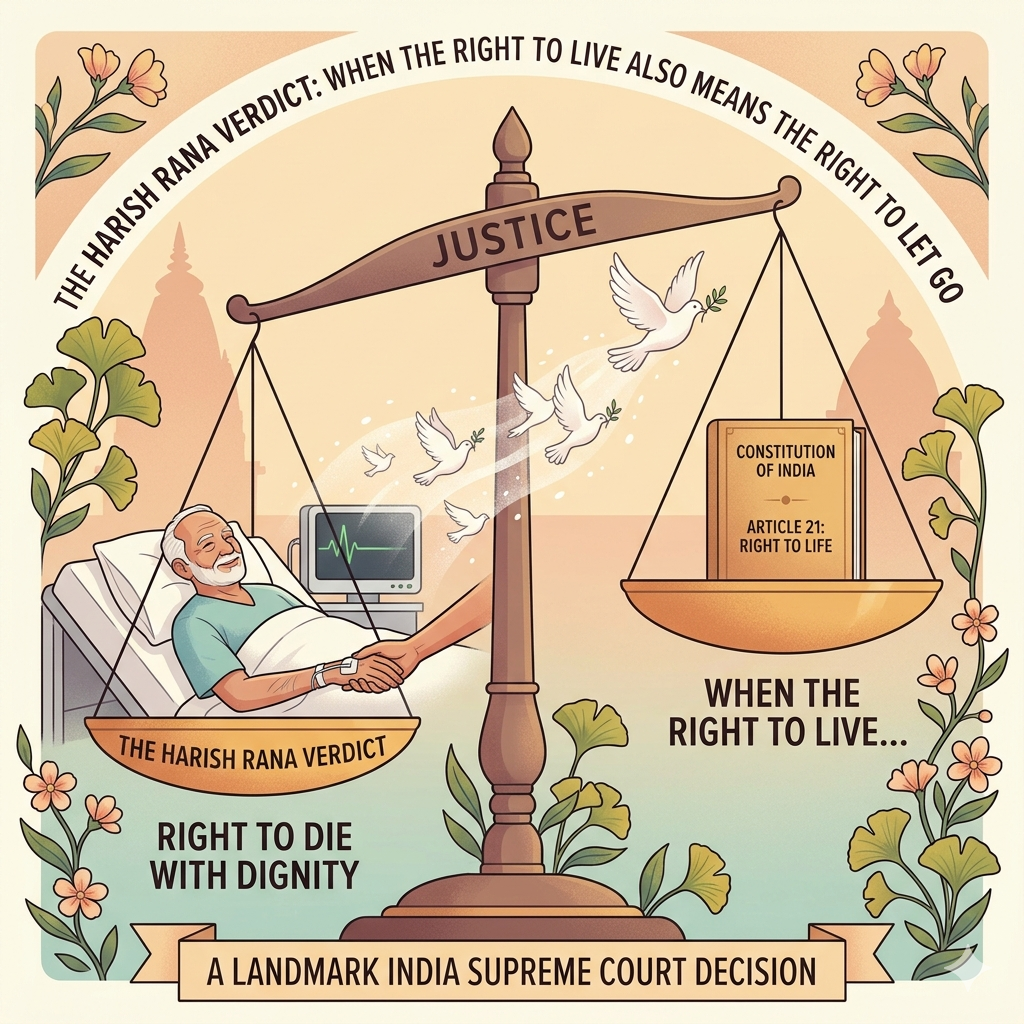
The Supreme Court’s decision on 11 March 2026 is India’s first explicit court-approved
withdrawal of life-sustaining treatment in a live case. It marks the practical culmination of a
three-decade evolution that began with outright rejection of any “right to die” and ended with
regulated recognition of passive euthanasia as part of the right to live with dignity under Article
21.
In Gian Kaur v. State of Punjab (1996), a five-judge Constitution Bench held that Article 21
does not include the right to die; therefore, active euthanasia remained unlawful. 5 Fifteen years
later, the case Aruna Ramchandra Shanbaug v. Union of India (2011) rejected active euthanasia
for the nurse in persistent vegetative state but permitted passive euthanasia under strict High
Court-supervised guidelines and medical board scrutiny. 6 A major turning point came with the
Common Cause (A Regd. Society) v. Union of India (2018) judgment. In a landmark move, the
five-judge Constitution Bench recognised the right to die with dignity as part of Article 21,
thereby legalising passive euthanasia, and had acknowledged Advance Medical Directives, or
living wills ( It is a legal, written document (a type of advance directive) that outlines your
preferences for medical treatment, such as life support or resuscitation, if you become terminally
ill, permanently unconscious, or otherwise unable to communicate your decisions. It ensures
your wishes are honoured, relieving families of difficult decision making) . 7 It drew the essential
distinction, that is, active euthanasia involves a positive act causing death (impermissible);
passive euthanasia is an omission or a withdrawal or withholding of futile treatment
(permissible). Furthermore, detailed procedural guidelines were laid down for cases with and
without living wills. 8
Practical difficulties in implementation led to modifications in 2023. The Court streamlined
timelines, reduced bureaucratic layers, and made the framework more workable for hospitals and
families. 9
Harish Rana’s case tested this evolved framework in the context of long-term home care. In
2024, his family approached the Delhi High Court seeking the withdrawal of CANH under the
Common Cause (A Regd. Society) v. Union of India (2018) guidelines. The petition was
dismissed on the ground that Harish was not on ‘mechanical’ ventilation and could sustain
himself without ‘extra external aid.’
The Supreme Court of India, while disposing of the parent SLP on 8 November 2024, directed
that he be provided home care, but granted liberty to seek further directions. 10
The present Miscellaneous Application (No 2238 of 2025) was filed when further deterioration
(including May 2025 hospitalisation and fresh tracheostomy) made continuation untenable. The
family prayed for constitution of medical boards and a declaration that CANH is medical
treatment. On 26 November and 11 December 2025, the Supreme Court directed constitution of
a primary board (Ghaziabad) and secondary board (AIIMS, New Delhi). 11
Both medical boards unanimously found Harish to be in an irreversible persistent vegetative state
(PVS) for 13 years, with negligible prospects of recovery. While continued CANH sustained his
survival, it offered no therapeutic benefit.
Family consultations that were held in person on 7 January 2026 and via videoconference on 8
January 2026 had revealed a clear and informed consensus, and after exhaustive efforts,
continued treatment served no meaningful purpose and only prolonged suffering. The parents
also expressed concern about their ability to provide future care, given their advancing age. 12
The Court meticulously revisited the Common Cause (A Regd. Society) v. Union of India (2018)
judgment and reaffirmed that CANH administered through a PEG tube constitutes ‘medical
treatment’ rather than basic care, which was a position drawn from Airedale NHS Trust v Bland[1993] AC 789 (HL). It clarified that withdrawal of such treatment does not amount to ‘causing
death’ but is an authorised omission that allows the underlying condition to take its natural
course.
The decision was guided by the ‘best interests’ principle, which includes considerations of
medical futility, the burden of treatment, dignity, and the views of the family. For patients
lacking decision-making capacity, such an omission is consistent with the doctor’s duty of care. 13
The judgment clarified procedural gaps for home-care patients and issued nationwide directions
to streamline implementation: Chief Medical Officers must maintain panels of doctors for
secondary boards; High Courts must instruct Judicial Magistrates of First Class to receive
intimations in unanimous cases; palliative and end-of-life care must accompany withdrawal. 14
In the operative order, the Court directed immediate withdrawal or withholding of CANH,
waived the 30-day reconsideration period due to unanimous consensus, and mandated AIIMS to
admit Harish for palliative care with full government support. 15
The verdict is historic for three reasons. First, it marks India’s first Supreme Court sanctioned
instance of passive euthanasia in practice. Second, it bridges the procedural vacuum for patients
in home settings. Third, it reinforces that the right to die with dignity is not merely theoretical,
but enforceable when continued treatment is futile and contrary to the patient’s best interests.
Yet the judgment repeatedly underscores the need for comprehensive legislation. Until
Parliament enacts a statute, the Common Cause guidelines (latest modified version) remain the
law of the land. Implementation challenges persist; medical professionals still face uncertainty,
and “discharge against medical advice” practices continue in some hospitals. The Court’s
directions to States and Union Territories for training, panel creation, and palliative infrastructure
are therefore critical.
For many law students and faculty, Harish Rana illustrates how constitutional values of dignity,
autonomy and privacy intersect with medical ethics and family reality. It reminds us that Article
21 protects not mere survival but meaningful existence. As the Court observed, the greatest
tragedy is not death but abandonment and prolonged undignified suffering.
Harish Rana’s case sits at the intersection of love, loss, medicine and mercy. His family’s 13-
year vigil, the medical boards’ clinical honesty, and the Supreme Court’s compassionate yet
principled reasoning together affirm that true dignity sometimes lies in allowing nature to take its
course. The judgment does not end the family’s grief, but it ends the daily mental agony of
watching a loved one trapped in a body that can neither live nor let go.
As the words of the ancient Subhashita quoted by the Court itself, mental worry burns the living
more fiercely than any funeral fire. On 11 March 2026, the Supreme Court chose mercy over
prolongation, dignity over mere existence. That choice marks a quiet but profound milestone in
Indian constitutional jurisprudence.
Endnotes
1 Henry Ward Beecher, quoted in Harish Rana v Union of India No 2238 of 2025 in SLP (C) No 18225 of 2024,
2026 INSC 222 (Supreme Court of India, 11 March 2026) para 1.
2 ibid
3 ibid paras 17–18 (Joint Report).
4 ibid paras 11–12 (disability certificates).
5 Gian Kaur v State of Punjab (1996) 2 SCC 648
6 Aruna Ramchandra Shanbaug v Union of India (2011) 4 SCC 454
7 Common Cause (A Regd Society) v Union of India (2018) 5 SCC 1 (hereafter Common Cause 2018).
8 ibid.
9 Common Cause v Union of India (2023) 14 SCC 131 (hereafter Common Cause 2023).
10 Harish Rana (n 1) paras 2–4.
11 ibid paras 13–16
12 ibid paras 17–21
13 ibid paras 111–231 (detailed analysis of best interests and CANH as treatment).
14 ibid paras 249–258 (safeguarding checkpoints and nationwide directions).
15 ibid paras 281–333 (final order).
Author is a student of 2nd Sem BA LLB