




Introduction
Medical negligence represents a complex intersection between healthcare
practice and legal accountability. Determining the circumstances under which a
doctor may be held criminally liable for negligence has long been debated in both
legal and medical communities. Courts must balance two important concerns:
protecting patients from careless medical treatment and ensuring that doctors are
not unfairly prosecuted for honest mistakes made in the course of professional
practice.
The Supreme Court of India addressed these concerns in Jacob Mathew v State
of Punjab (2005), which remains one of the most influential decisions on criminal
medical negligence. The judgment clarified the distinction between civil and
criminal negligence in medical practice and laid down safeguards against the
indiscriminate prosecution of doctors.
This case comment examines the facts, legal issues, judicial reasoning and
implications of the decision. It further analyses the broader impact of the ruling on
medical jurisprudence in India and evaluates its effectiveness in balancing
patient protection with professional autonomy.
Facts of the Case
The case originated from an incident that occurred in a private hospital in Punjab
in 1995. A patient suffering from respiratory distress was admitted and required
immediate oxygen support. The attending doctors attempted to administer
oxygen through a cylinder available in the hospital. However, it was later
discovered that the cylinder was empty.
Another oxygen cylinder was arranged, but by that time the patient had already
passed away. The relatives of the deceased alleged that the doctors had failed to
provide proper medical care and claimed that the absence of oxygen in the
cylinder amounted to negligence.
Based on this allegation, criminal proceedings were initiated against the doctors
under Section 304A of the Indian Penal Code for causing death by negligence.
One of the accused doctors, Jacob Mathew, challenged the prosecution and
sought relief from the courts. The matter ultimately reached the Supreme Court,
which had to determine whether the circumstances amounted to criminal
negligence or merely indicated a civil liability arising from a medical error.
Legal Issues
The Supreme Court considered several key legal questions:
1. Whether the conduct of the doctors amounted to criminal negligence under
Section 304A of the Indian Penal Code.
2. What standard should be applied to determine negligence in the medical
profession.
3. Whether medical practitioners can be prosecuted for criminal negligence
without establishing gross negligence.
4. What procedural safeguards should exist before initiating criminal proceedings
against doctors.
These issues were crucial in defining the scope of criminal liability for medical
professionals in India.
Arguments of the Parties
Prosecution’s Arguments
The prosecution argued that hospital authorities had a duty to ensure that
essential life‑saving equipment such as oxygen cylinders was available and
functional. According to the complainant, the failure to verify the oxygen supply
demonstrated negligence on the part of the doctors.
It was further argued that this lapse directly resulted in the death of the patient
and therefore criminal liability should arise under Section 304A of the Indian
Penal Code.
Defence’s Arguments
The defence contended that medical professionals cannot be held criminally
responsible for every unfortunate medical outcome. The mere occurrence of
death does not automatically prove negligence.
The defence relied on the principle that a doctor should not be considered
negligent if the treatment provided conforms to a practice accepted by a
responsible body of medical professionals skilled in that field. This principle,
known as the Bolam Test, has been widely recognised as a standard for
determining professional negligence.
Court’s Reasoning
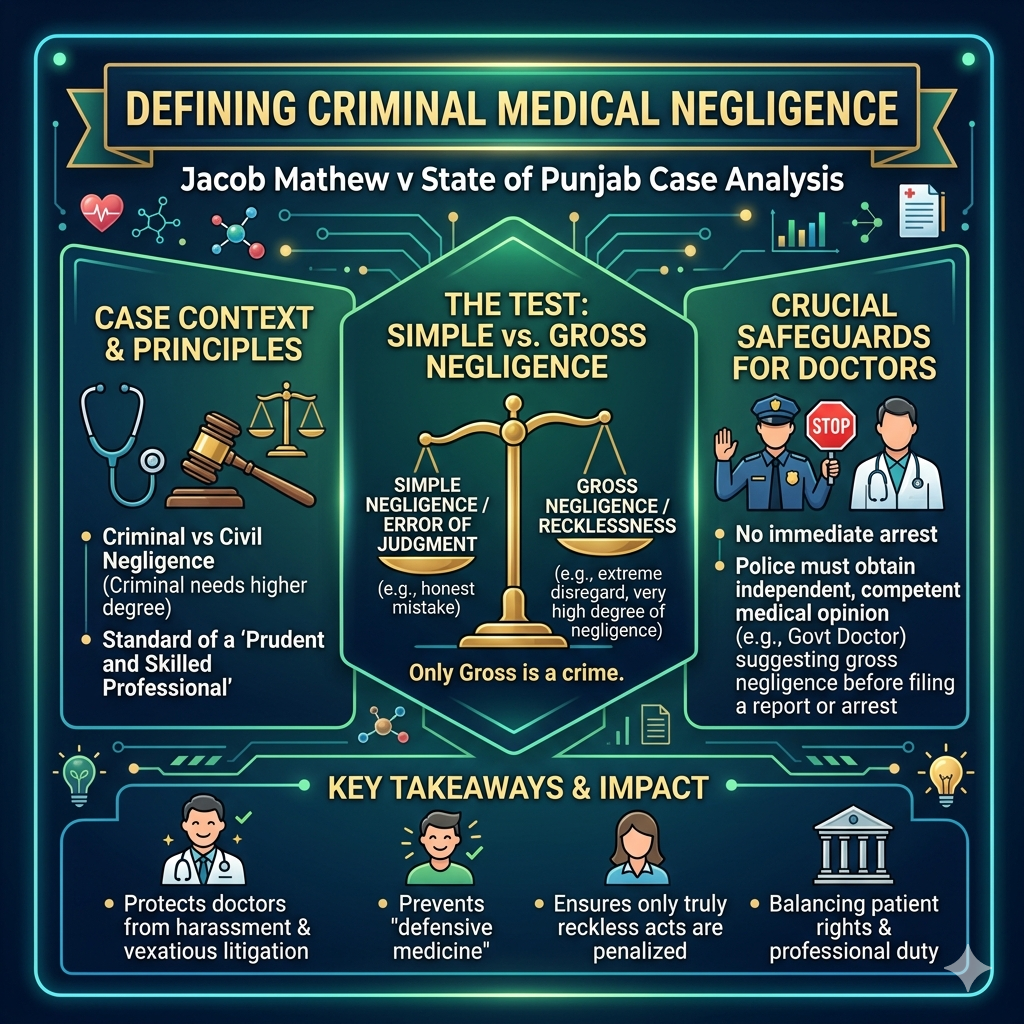
The Supreme Court examined the concept of negligence within criminal law and
emphasised that negligence may give rise to both civil and criminal liability, but
the threshold for criminal liability is significantly higher.
Civil negligence arises when a professional fails to exercise reasonable care
expected in the circumstances. Criminal negligence, however, requires
negligence of a very high degree, often described as gross negligence. The
Court observed that an error of judgment or an accidental failure during treatment
does not automatically constitute criminal negligence.
In determining the appropriate standard of care for medical professionals, the
Court referred to the principles laid down in Bolam v Friern Hospital Management
Committee (1957). According to this principle, a doctor cannot be considered
negligent if the chosen course of treatment is supported by a responsible body of
medical professionals skilled in the relevant field.
The Court acknowledged that medicine is not an exact science and that doctors
frequently make decisions in situations involving uncertainty and urgency.
Therefore, imposing criminal liability for every unsuccessful medical outcome
would create fear among medical practitioners and could discourage them from
performing their professional duties effectively.
Another significant aspect of the judgment was the introduction of procedural
safeguards. The Court held that before initiating criminal proceedings against a
doctor for medical negligence, the investigating authorities should obtain an
independent and competent medical opinion. This requirement ensures that
allegations of negligence are examined by qualified experts before criminal
action is taken.
Judgment
After examining the available evidence, the Supreme Court concluded that the
material on record did not establish gross negligence on the part of the doctors.
The Court observed that the mere absence of oxygen in the cylinder was
insufficient to prove criminal negligence without evidence of reckless or highly
negligent conduct.
Accordingly, the Court quashed the criminal proceedings initiated against the
accused doctors. However, it clarified that the decision did not prevent the family
of the deceased from pursuing civil remedies if negligence could be established
through appropriate legal proceedings.
The judgment also laid down important guidelines for prosecuting medical
professionals in cases involving alleged criminal negligence. These guidelines
emphasised caution and the need for expert medical evaluation before initiating
criminal prosecution.
Critical Analysis
The ruling in Jacob Mathew v State of Punjab represents a significant
development in Indian medical jurisprudence. By distinguishing between civil
negligence and criminal negligence, the Supreme Court ensured that criminal
liability would arise only in cases involving serious misconduct.
One of the most important aspects of the judgment is its recognition of the
realities of medical practice. Doctors often work in stressful environments and
must make decisions based on limited information. The requirement of gross
negligence ensures that medical professionals are not punished merely for
mistakes made in good faith.
Another important contribution of the judgment is the requirement of an
independent medical opinion before initiating criminal proceedings. This
safeguard helps prevent harassment of medical professionals through baseless
complaints.
However, the judgment has also attracted criticism. Some scholars argue that the
high threshold of gross negligence may make it difficult for victims of medical
negligence to obtain justice in criminal courts. Despite such concerns, the
decision continues to serve as an important precedent guiding courts in cases
involving medical negligence.
Conclusion
The decision in Jacob Mathew v State of Punjab plays a crucial role in defining
the legal boundaries of criminal liability for medical negligence in India. By
requiring proof of gross negligence and introducing safeguards against
unwarranted prosecution, the Supreme Court provided clarity in an area of law
that had previously been uncertain.
The judgment reflects an attempt to balance two important objectives: protecting
patients from negligent treatment and ensuring that doctors are not unfairly
subjected to criminal prosecution for honest professional decisions. As
healthcare systems continue to evolve, the principles laid down in this case
remain a vital reference point in determining the scope of criminal liability in
medical practice.
Endnotes
1. Jacob Mathew v State of Punjab (2005) 6 SCC 1.
2. Indian Penal Code 1860, s 304A.
3. Bolam v Friern Hospital Management Committee [1957] 1 WLR 582.
4. Jacob Mathew v State of Punjab (2005) 6 SCC 1, para 10.
5. ibid para 48.
6. ibid para 50.
7. ibid para 52.
Author is student of 4th Sem BBA LLB (A)