




Historically, menstruation remained concealed by silence, euphemisms, and deep-seated
stigma. It was only as women moved into the formal workforce, the link between biological
health and labour rights began to receive serious attention. To an outsider, a menstrual cycle
might seem like a minor monthly inconvenience. However, for millions of women, it is a
complex physiological event often accompanied by Dysmenorrhea, marked by severe
cramping that disrupts daily functioning. 1
During menstruation, the uterus contracts to shed its lining, releasing prostaglandins,
chemical compounds that trigger inflammation and pain signals. Data indicate that roughly
seven in every ten women experience menstrual pain and related difficulties to varying
degrees. 2 For some, the pain is debilitating, described in medical literature as comparable in
intensity to a heart attack. Such severity makes it impossible to function normally in a
standard work environment.
Despite this physiological reality, competitive modern work culture often treats admitting to
such pain as a sign of weakness or lack of commitment. This brings the discussion to a
critical point regarding equality. True workplace equity cannot be measured by identical
treatment when biological realities are fundamentally asymmetrical.
This is where the question of paid menstrual leave arises, not as a special privilege, but as a
necessary adjustment to level the playing field. Recognising this need is the first step toward
dismantling stigma and creating a policy framework that respects both productivity and
human biology. The following analysis explores how this framework can be constructed
within the Indian context, weighing the judicial landscape against the practical realities of
different employment sectors.
THE LEGAL LANDSCAPE IN INDIA
The regulatory framework surrounding menstrual leave in India is characterized by a
significant disconnect between state-level initiatives and central legislation. Even though the
Supreme Court of India has recognized menstrual health as a fundamental right under Article
21 (Right to Life and Dignity), 3 currently, there is no overarching central law mandating paid
menstruation leave, nor is there a unified directive governing its implementation across the
country. This legislative vacuum leaves the policy largely to the discretion of individual states
and private employers. Bihar stands as a historical pioneer, having introduced a policy in
1992 that grants women employees two days of paid menstrual leave per month. 4 Decades
later, Kerala followed suit in 2023, extending leave provisions to female students in
universities and institutions, alongside maternity leave provisions for students above the age
of 18. 5 In the private sector, a handful of progressive corporations such as Zomato, Swiggy,
and Byjus have introduced their own internal policies, with Zomato announcing ten days of
paid period leave per year in 2020. 6 However, these remain isolated exceptions rather than the
norm.
Attempts to codify this right at the national level have consistently stalled. The Parliament
has witnessed several failed legislative efforts, including the Menstruation Benefits Bill of
2017 and the Women's Sexual, Reproductive and Menstrual Rights Bill in 2018. 7 More
recently, the Right of Women to Menstrual Leave and Free Access to Menstrual Health
Products Bill, 2022, proposed three days of paid leave for women and transwomen, citing
research that 40% of girls miss school during their periods and 65% report an impact on daily
activities. 8 Despite these efforts, the legal status remains uncertain. Proponents often anchor
their arguments in the Constitution of India, specifically Article 15(3), which permits special
provisions for women, thereby countering claims of discrimination against men. Furthermore,
Article 42 mandates the state to ensure "just and humane conditions of work," which
advocates argue should inherently include accommodations for biological processes such as
menstruation. 9 Yet, without statutory backing, these constitutional ideals remain only
aspirational.
MERITS AND DEMERITS: A CRITICAL ANALYSIS
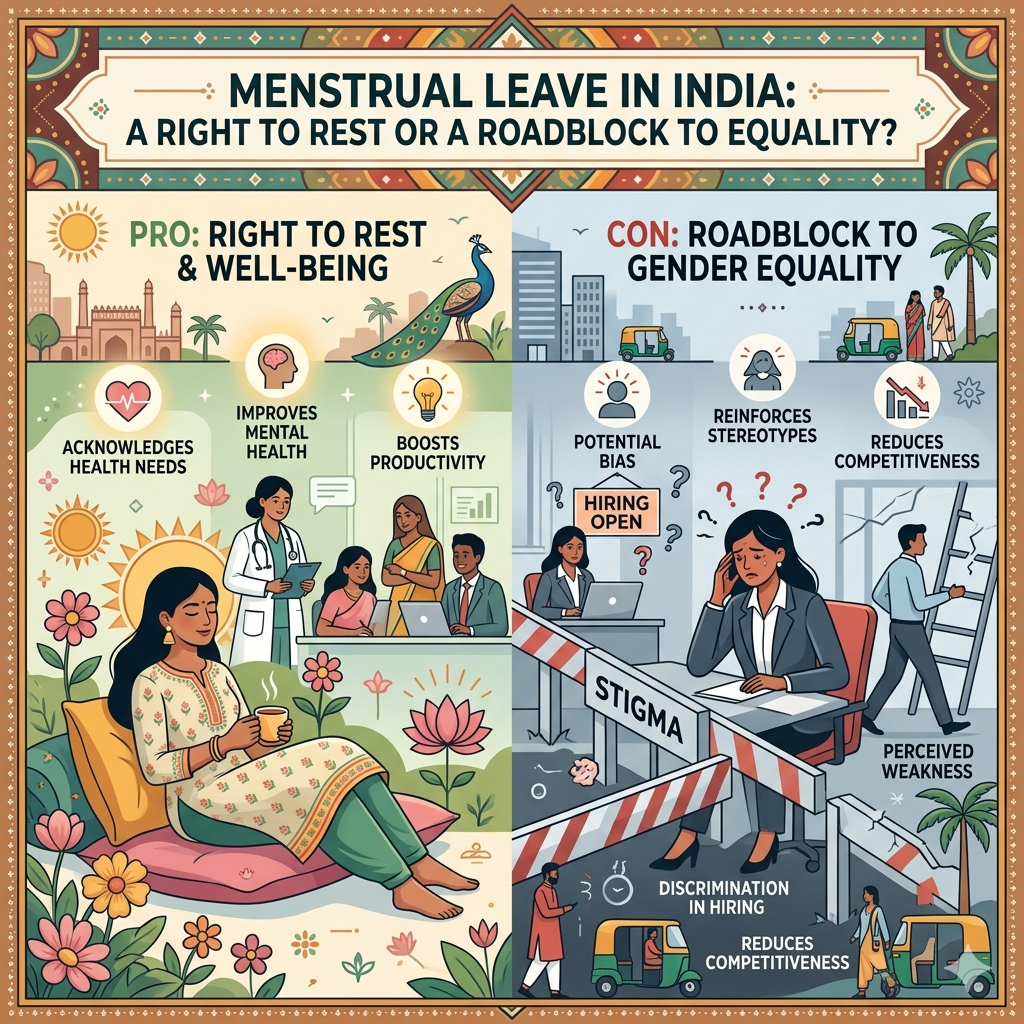
Women across all sectors face distinct challenges bound by a common reality. This analysis
categorises them into three domains: education, white-collar professions, and informal labour
to examine the specific merits and demerits of menstrual leave within each context.
1. The Academic Sphere: School and College Students
In educational institutions, menstrual leave, such as Kerala's recent provision for universities,
can play a vital role in supporting academic continuity. Its chief advantage is protecting
attendance records and reducing dropout rates among adolescent girls. Formalising leave
acknowledges a biological reality and this recognition can help normalise the conversations
around menstrual health.
Yet, the risks of implementation are considerable. Privacy remains a central concern: the Bhuj
incident, where girls were asked to prove their menstrual status, illustrates how policies
meant to protect can become instruments of humiliation. 10 In school settings, where peer
dynamics are intense, singling out girls for special leave may invite stigma or ridicule.
Without careful design and strict confidentiality, menstrual leave in education may
unintentionally reinforce the very barriers it aims to remove.
2. The Formal Economy: White-Collar and Professional Jobs
In corporate, teaching, legal, and other professional settings, menstrual leave is often
discussed in terms of productivity and retention. Economic analyses, including IMF
projections, suggest that supporting women's workforce participation could significantly
boost India's GDP 11 . Paid leave enables professionals to manage severe symptoms without
losing income, reducing "presenteeism" where employees are present but unable to perform
due to pain. Forward-looking companies like Zomato and Swiggy have adopted such policies
as part of their employee welfare framework, potentially strengthening loyalty and employer
reputation. 12 Flexible alternatives, including remote work options during acute days, offer a
pragmatic balance between health and productivity.
However, the corporate environment also carries heightened risks of bias. As noted in recent
judicial observations, mandating monthly leave may lead employers to view women as a cost
liability, subtly influencing hiring decisions. 13 A parallel can be drawn with the employment
challenges faced by persons with disabilities: well-intentioned mandates, without supportive
incentives, can discourage recruitment altogether. Introducing menstrual leave without
addressing the underlying prejudices could reinforce the perception that women are less
reliable, narrowing opportunities at entry and mid-levels. Career progression may also suffer
if employees using such leave are informally marked as less committed. Moreover,
requirements for medical documentation, as in Spain's model, risk intruding on privacy and
adding bureaucratic friction. Unless workplace culture actively normalises health-related
leave, women may feel compelled to hide their usage, rendering the policy ineffective while
still bearing the stigma of having accessed it.
3. The Informal and Physical Labour Sector
For women in construction, agriculture, and informal labour, the conversation around
menstrual leave moves beyond career concerns to basic safety and wage security. The core
merit here is protection: physically demanding work operating machinery, standing for hours,
lifting loads, combined with menstrual pain, can heighten health risks and increase the chance
of workplace injury. Recognising this through leave provisions affirms that their health
matters and aligns with the constitutional vision of "just and humane conditions of work." 14
However, the demerits in this sector are structural and economic rather than cultural. The vast
majority of women in hard labour jobs are daily wage earners; for them, "leave" inherently
means "no pay." Without a government-backed wage compensation mechanism, a mandate
for leave is practically useless. The Gujarat tribal health study highlights this infrastructure
gap; with many households located far from care facilities and lacking transport, accessing
even basic health support is difficult, let alone taking sanctioned leave 15 . Furthermore, the
informal sector lacks human resources departments to enforce rights. Therefore, while the
moral argument for leave is strongest here due to the physical toll, the economic reality
makes it the most difficult to implement without direct state subsidy and rigorous
enforcement mechanisms that currently do not exist.
GLOBAL PERSPECTIVE ON MENSTRUAL LEAVE
India's hesitation contrasts with several nations that have institutionalised menstrual leave,
offering a comparative framework for analysis. Countries such as Japan, Indonesia, the
Philippines, Taiwan, South Korea, Zambia, and Vietnam have implemented varying forms of
menstrual leave 16 . Spain recently became the first European country to grant paid menstrual
leave to workers, entitlements ranging from three to five days per month 17 . However, the
existence of law does not guarantee utilization. In Japan, where a law has existed since 1947,
and in South Korea, usage rates remain low due to entrenched workplace culture and stigma.
This suggests that legislation is merely a tool; cultural acceptance is the driver. 18 The global
experience indicates that while paid leave is a progressive step, it must be accompanied by a
shift in organizational culture to prevent the marginalization of women. The Spanish model,
which treats menstrual pain as a legitimate health condition requiring medical certification,
offers a structured approach, but it also raises questions about privacy and medical burden
that India must consider carefully. 19
THE BEST PATH FOR INDIA: A WAY FORWARD
Given India's complex socio-economic landscape, a blanket mandatory law on menstrual
leave may not be the most effective immediate solution. A more pragmatic path lies in a
hybrid approach that emphasises flexibility, incentives, and infrastructure. Prioritising
menstrual health literacy is essential for employers, employees, and medical practitioners
need access to reliable information to differentiate between routine discomfort and period
pain.
Instead of rigid leave mandates, workplaces could integrate adequate rest breaks, flexible
working arrangements, and the option to work from home during severe pain. Providing
designated rest spaces and short mid-shift breaks can further support those who need them..
This balanced approach fosters inclusivity without compromising operational efficiency.
To mitigate the risk of hiring discrimination, the government could incentivise menstrual
leave policies by providing tax exemptions to companies that offer them or by introducing
gender-neutral leave policies that encompass various health needs. 20 Consideration could also
be given to government aid covering leave costs through Direct Benefit Transfer (DBT),
thereby removing the financial burden from employers. Simultaneously, access to effective
treatment must be ensured; workplaces should provide free emergency period products and
pain medication, supported by the existing National Guidelines on Menstrual Hygiene
Management 21 .
Finally, improving global minimum labour standards regarding work hours, wages, and
health safety would create an environment where separate menstrual leave policies become
less critical because the workplace itself becomes humane enough to accommodate health
fluctuations naturally. By focusing on flexibility and incentives rather than rigid mandates,
India can protect women's health without inadvertently compromising their economic
opportunities.
1 World Health Organization, 'Dysmenorrhea' (Fact Sheet, 2023) https://www.who.int/news-room/fact-
sheets/detail/dysmenorrhea accessed 12 March 2026.
2 National Family Health Survey-5, 'India Report' (Ministry of Health and Family Welfare 2021) vol 1, 285.
3 Shailendra Mani Tripathi v. Union of India (2026) Writ petition (civil) No. 172/2023, (recognizing that 'the
right to menstrual health and access to proper menstrual hygiene management facilities are intrinsic to the right
to life guaranteed under art 21 of the Constitution of India').
4 Bihar Government, 'Resolution No. 4408' (Department of Personnel and Administrative Reform 1992).
5 Kerala Government, 'Order No. 1/2023/HE' (Higher Education Department 2023) para 2.
6 India Today, ‘After Swiggy and Zomato, another company announces period leave for women employees’
(India Today, 22 December 2022) https://www.indiatoday.in/technology/news/story/after-swiggy-and-zomato-
another-company-announces-period-leave-for-women-employees-2312424-2022-12-22 accessed 26 March
2026.
7 The Menstruation Benefits Bill 2017, cl 3; The Women's Sexual, Reproductive and Menstrual Rights Bill
2018, cl 5.
8 The Right of Women to Menstrual Leave and Free Access to Menstrual Health Products Bill 2022, cl 4(1).
9 The Constitution of India 1950, art 15(3) and art 42.
10 '66 Girls Forced to Strip to Prove Menstruation in Gujarat' The Hindu (Bhuj, 14 September 2020)
https://www.thehindu.com/news/national/gujarat/66-girls-forced-to-strip-to-prove-menstruation-in-
gujarat/article32623776.ece, accessed 20 March 2026.
11 McKinsey Global Institute, 'The Power of Parity: How Advancing Women's Equality Can Add $12 Trillion to
Global Growth' (2015) 12.
12 India Today (n 6)
13 Garima Abhi Pratap Singh v Union of India (2024) Supreme Court Order dated 22 January 2024, para 4.
14 Vishaka v State of Rajasthan (1997) 6 SCC 241, para 10.
15 Directorate of Health Services, 'Maternal Healthcare Access in Tribal Districts of Gujarat' (Government of
Gujarat 2022) 15-18.
16 GWL Team, ‘Menstrual Leave Policies from 7 Countries across the Globe’ (Global Woman Leader, 2022)
https://www.globalwomanleader.com/viewpoint/experts-column/menstrual-leave-policies-from-7-countries-
across-the-globe-nwid-219.html accessed 26 March 2026.
17 Organic Law 1/2023 (Spain) Boletín Oficial del Estado no 28, 2 March 2023, art 4.
18 Labour Standards Act 1947 (Japan) art 68.
19 Organic Law 1/2023 (n 15), art 4.
20 NITI Aayog, 'Strategy for New India @ 75' (2018) 115.
21 Ministry of Health and Family Welfare, 'National Guidelines on Menstrual Hygiene Management'
(Government of India 2019) 22.
Author is student of 8th Sem BBA